Showing posts with label psychology. Show all posts

Friday, January 7

Boy Genius, Interrupted: A Psychological Profile of Dexter

Dexter. A two foot tall, 9-year-old American boy genius with an inexplicable Russian accent, glasses, and his own secret laboratory behind a bookcase in his bedroom. What else is there to know? 

A lot, in fact. 

With my bounty of free time over the holidays, Dexter’s Lab re-runs and the Season 1 DVD, and 4/5ths of a Psychology degree, I decided to put him under my lens to see just what makes our favorite animated boy genius tick.
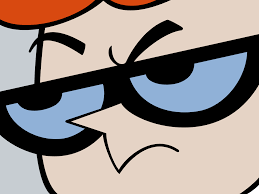
"...Oh Boy."
Dexter exemplifies the experience of isolation and social awkwardness that many children face as they try to discern their place in the world. The maturation process doesn’t end in adulthood; it is a life-long journey that culminates in, what humanist psychologist Abraham Maslow called, “self-actualization:” 

"What a man can be - he must be, this need we may call self-actualization. It refers to the desire of self-fulfillment, namely to the tendency for him to become actualized in what he is potentially. This tendency might be phrased as the desire to become more and more what one is, to become everything that one is capable of becoming."

Maslow created a pyramid-shaped diagram of human needs broken down by their priority and urgency to which they must be addressed in one’s life. This diagram is referred to as Maslow’s “Hierarchy of Needs” and it has 5 distinct levels:


The needs at the bottom of the pyramid naturally take up the most space because you can’t build a stable pyramid without a solid foundation. Although they are the most primal and basic, they are integral to survival and ultimately transcendence to the next level of self-actualization.

Fact: You can’t find out who you are and the value of your existence if you starve to death or get eaten by bears first.

The theory is that once the more fundamental physiological and safety needs are fulfilled, you can then focus on fulfilling the needs of love and belonging, self-esteem, and ultimately, the satisfaction that comes from realizing your potential and existing with a sense of purpose, authenticity, and vitality. 
If we skip a step, whether out of ignorance, arrogance, or impatience, our pyramid will topple and we’ll have to continually rebuild from the ground up. 

Although Genndy Tartakovsky most likely didn’t consult Maslow’s pyramid when creating Dexter’s Lab, I find it interesting that most of the episodes end with the destruction of his lab, sometimes by Dee Dee’s hand but more often resulting from some misstep of his own. Usually Dexter overestimates his ability, ignores advice, or miscalculates at some point in the episode, which sets the stage for his downfall each and every time. Every journey experiences some turbulence here and there, but when strife occurs as frequently as it does in Dexter’s life, Maslow would probably say he needs to re-evaluate how he’s going about his actualization process and make sure he's not trying to go out of order.

"I pity the fool who don't understand that it's called a hierarchy for a reason."
Dexter is financially provided for and lives in a safe middle class neighborhood in Suburbia so his Physical and Safety needs are taken care of which puts him higher on the ladder of actualization than many. The search for true love and acceptance from other human beings however, poses one of life’s greatest challenges whether you’re a 9-year-old science geek with a weird accent, or a senile cat lady named Dorris.

What makes this stage such a challenge is that we can’t force others to love us, like us, or even tolerate us. There are so many external factors that can dictate our acceptance or rejection from the pack: weight, color, class, acne, unconventional hobbies, an aversion to showering, etc. As Raisin in the Sun playwright Lorraine Hansberry once said, “That which makes you exceptional, if you are at all, is inevitably that which will also make you lonely.” 
"I love how you just get me, Lorraine."
Dexter is lonely. How much of his loneliness is based on external rejection and how much of it is self-imposed is another story entirely. To some extent, Dexter embodies Dr. Carol Pearson’s “Orphan archetype” which rebels against the world and says “Who needs ‘em? I can do this on my own.” Dexter does not actively seek friendships and instead isolates himself in his lab all day to perfect his experiments. I think he somehow fantasizes that once he uses his genius to distinguish himself from the hoi polloi, he will suddenly gain acceptance or at least admiration from the world. 

He has created an unhealthy cycle wherein he ignores his need for human intimacy to instead focus on building esteem, but his self-esteem is almost entirely based on the opinions and accolades of the very people with which he had no desire to build relationships in the first place. Oy.

In the episode Average Joe, Dexter gets the wrong IQ test results and completely loses his sense of self when he is labeled simply “average.” He forces himself to adopt a new social circle, new habits, and new style of dress because he no longer has a grasp of who he is. His identity is directly linked to his status as a boy genius. Outside of that, he is a very insecure and confused individual who craves simultaneously belonging to a community and standing apart from the crowd yet can only seem to do one or the other.

Much to his chagrin, the closest social bond he has in his life to someone who isn’t his beloved computer, would be with his annoying older sister, Dee Dee. Although he has countless security measures to keep out intruders, Dee Dee – whose brain capacity is about on par with that of marmalade-- always finds a way to infiltrate his lair and mess with his experiments. He knows his sister is not a source of intellectual competition for him yet she is always able to push his buttons (often literally). When Dee Dee needles him about his short stature, faulty vision, physical weakness, and sense of style, Dex is rattled to his core.

"What's wrong with his sense of style? Well, aside from his glaring lack of a color coordinated fez and bow tie, that is."
Like most children, he is extremely sensitive regarding his shortcomings (no pun intended…okay maybe a little bit) and often tries to overcompensate. His sole mission in several episodes is to create a machine that will turn him into an adult with dashing good looks, broad shoulders, and a stature that commands respect from his parents, his peers, and his cute baby-sitter. He idolizes TV hero Action Hank because Hank is the archetype of machismo, the epitome of everything Dexter -- with his cumbersome intellect, distaste for the outdoors, and muscles with the consistency of fettuccini-- will probably never be.

Insecurity dictates nearly all of Dexter’s interactions with his intellectual peers. He resents his nemesis, Mandark, for lording his superior laboratory facilities over him and constantly reminding the vertically-challenged redhead that he is merely a second rate version of himself. When Dexter finds his genius doppelganger family at the grocery store, he is eager to experience life with like-minded science-centric parents whose idea of fun is mandatory pamphlet reading time and measuring the scientific properties of fruit but he realizes he can’t stand out in a family of geniuses. When he transforms his sister into a fellow braniac to serve as his lab assistant, his insecurities run rampant because she is not a subservient source of accolades, but a threat to his intellectual status. 

He thinks he craves empathetic companions who would truly appreciate his scientific prowess but in each confrontation with a fellow genius he soon realizes that he lacks the stamina and self-assurance to survive amongst people like himself. By consistently disturbing the Needs Hierarchy and prioritizing Esteem over Belonging, Dexter now approaches relationships in an unhealthy manner where he sees people as merely a means to an end.  Since building himself up is all that matters, when it comes to companionship he simply wants someone who can reflect his genius back to him, not necessarily someone to challenge him or help him grow. 

In his world, there’s only room for one Dexter.
Okay, scrap that theory.
Ultimately it would seem as though his insecurities cause him to isolate himself so he is really only competing against himself yet, as we all know, we can be our own worst critics and our fiercest competition. Psychoanalyst Karen Horney listed 10 “Neurotic Needs” that motivate different types of people and would probably infer that Dexter’s neurosis is the “Need for Personal Achievement.” Writer Kendra Cherry explains:

“According to Horney, people push themselves to achieve greater and greater things as a result of basic insecurity. These individuals fear failure and feel a constant need to accomplish more than other people and to top even their own earlier successes."

The need for him to constantly build bigger and better experiments is of an internal nature so there is no external litmus test to measure his success or failure, therefore he can keep competing with himself indefinitely and never satisfy his achievement quota.

His need for creation may also be a means to distract from and suppress his destructive tendencies. On several occasions, we see beneath his unfeeling, analytic demeanor and get a glimpse of his almost demonic lust for power and domination. For him, scientific creation serves as a socially acceptable outlet into which he can channel his manic and borderline-sociopathic energy. Note that although not necessarily the original intent, many of his creations have the capacity to harm and cause mayhem and nearly all of them come equipped with self-destruct buttons.

Flawless Victory. Dexter Wins.
As psychoanalyst and crack-addict Sigmund Freud would say, Dexter’s primal subconscious, or Id, is constantly battling his morally upright Superego for dominance in his psyche. When the Id is allowed to dominate, level-headed analytical Dexter is consumed by the Dexter that just wants to conquer civilization while laughing maniacally and setting things on fire. When his Superego is dominant, the Id is suppressed and his inner megalomaniac is relegated to the backseat. For the time being.

In The Way of the Dee Dee, we see Dexter drop his stoic facade on his path to emotional freedom with Dee Dee as his guru. At first he only reluctantly adheres to his sister’s loose, care-free lifestyle. Within minutes however, the student surpasses the teacher and Dee Dee realizes too late that by taking away his structure and inhibitions she’s unleashed his inner monster. “No longer the quiet creator but a mad destroyer,” she laments as she surveys her brother sadistically laying waste to his once-prized laboratory in an Id-riddled frenzy. Dexter’s primal urges are so much more pronounced because a) he was drawn that way and b) he doesn’t process his deeper, darker emotions so they fester and swell in the bowels of his subconscious until the Id finally comes out to play and wreak havoc.


Dexter is still young, and although he is extremely intellectually precocious, he has a lot to learn about life, love, and happiness. Until he learns that self-actualization is not a race but a process, and cutting corners or skipping steps only sabotages his efforts, he will be doomed to continue his cycle of insecurity and arrogance, creation and destruction, craving the world and a rejecting it. Once he stops viewing others as usable objects and learns the value of true companionship, thereby accepting the human need for love and other people, he will finally be able to give love and be loved.
When you're animated, Jazz hands are always appropriate.


Thursday, November 4

Halloween Psych 101: Lesson IV - Sparkling Vampires: A Fate Sexier Than Death?

       I'll admit there's something to be said for movies that feature full out Godzilla-type monsters, savage animals like Cujo and Jaws, or whatever combination of giant/mutant/hybrid creatures that Syfy Channel dreams up for their movie of the week.

Man, I wish.

        And that something was said like two articles back.

      Sure, wild dogs eating small children are entertaining and mutated creatures stepping on overpopulated Japanese cities are fun every once in a while, but humans are so much more fascinating than animals are as the story focal point. Humans have the potential for both extreme evil (as we also saw in Blog numero uno) and superhuman heroics which makes them more compelling and dynamic to watch on screen.

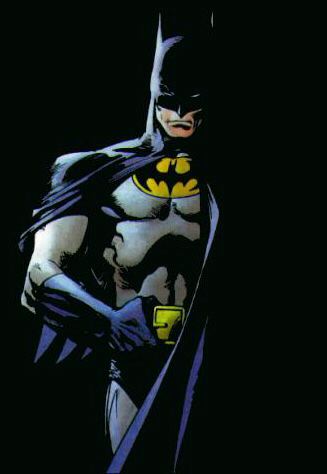
       That’s why I don’t think comic books superhero franchises are ever going to fall out of favor. We need these figures to look up to for hope and inspiration. While murderers and psychopaths help us deal with the potential of evil in our natures, superheroes show us the potential for greatness within us. We can relate to Bruce Wayne, Peter Parker, and Bruce Banner because they are humans that fell into extraordinary circumstances and rose to the occasion (sometimes with the help of a little radioactive mutation but hey, who’s judging?).  

          It’s why we cling to news stories that trumpet human bravery such as when a mother summons some sort of gorilla strength reserve and lifts a car off of her child, or when people like Wesley Autrey jump on the subway tracks to save a fallen seizure victim as the train’s about to arrive. We’d like to think we would have that kind of courage, strength, or quick-wittedness (is that a word?) about us when the going gets tough. But this particular article is not about the hero within us. It’s about how we’re all a bunch of superstitious, sniveling pansies.

In what is probably my favorite movie of all time, Clue, the 1985 spoof on the Parker Brothers board game, the degrees of human fear are put on display for the amusement of the 80s viewing audience.
Which probably looked something like this.
While writing this article, a specific exchange of dialogue came to mind from a short scene between Professor Plum and Mrs. Peacock when the bunch decides to split and search the house for the murderer. You’ll find the specific exchange at 5:50 in the clip below, although I’d recommend watching the whole clip and then maybe watching another and then proceeding to purchase this movie because it’s brilliant and Madeline Kahn will judge you from Heaven if you don’t. And you don’t want that.

          So what does it really mean to meet the proverbial “fate worse than death?” According to a random site I found online, because I’m all for reliable sources, the phrase had appeared throughout literature for years but was most popularized in this specific wording by writer Edgar Rice Burroughs in his 1914 novel, Tarzan of the Apes.

“The ape threw her roughly across his broad, hairy shoulders, and leaped back into the trees, bearing Jane Porter away toward a fate a thousand times worse than death”
I think Jane fared pretty well in the fate department actually.
       To understand what fate could possibly be considered worse than death, we need to first understand what the public at large is most afraid of. In a Gallup poll taken in 2001, Americans listed their top 10 worst fears as follows:
          Although some of these fears are lame and have to do with basic anxieties, many of them are things that could potentially result in death. People don’t necessarily fear heights as much as they fear falling from heights. That’s sound logic. 

And let me just represent for the fellow claustrophobics: it’s not necessarily the fear of being in an enclosed space; it’s the fear of running out of air and not being able to get out of said enclosed space if I were to have a panic attack or emergency. It’s not unreasonable. Throughout history people have been terrified of being locked in creepy basements during Halloween party shenanigans (see: Blog #2) or trapped in other enclosed spaces like a coffin with absolutely no way out. 

In an old-timey Australian pamphlet lauding the advantages of cremation, point #10 astutely pointed out: “Cremation leaves no possibility of being buried alive.” It’s why some people today have intercoms installed to alert the public from six-feet-under, “I’m not dead yet!”   Being buried alive is timeless enough of a fear that back in the day Poe milked it for all it was worth in stories like “The Casque of Amontillado” and we even see the same claustrophobic motif employed in modern movies like Tarantino's Kill Bill vol. II. That’s right E-Pizzle and QT just got shout outs in the same sentence. Deal with it.

What’s really interesting about this fear is that alleged instances of premature burial are believed to have actually spawned many vampire and zombie rumors. In Haiti, zombies are believed to have been created when villagers observed the victim in a deep paralysis that mimicked death (caused by the tetrodotoxin of the puffer fish). Corpses of the presumed dead would be buried alive and eventually wake up and wander home somewhat disgruntled. There is no documentation of getting the munchies for brains though. Yet.

Vampire hysteria spread throughout the Balkans in the 18th century with people wounding each other with fatal bites, restless noises coming from grave sites, and fatal outbreaks of unexplained illnesses featuring blood dripping from the sufferer’s lips. Researchers assume instances of biting can be contributed to rabies while epidemics of tuberculosis and bubonic plague in small villages caused victims to constantly cough up and reek of blood. According to Jean Marigny, author of Vampires: Restless Creatures of the Night, scratch marks found on the inside of exhumed coffins indicated cases of people that had awaken from faux deaths and had attempted to claw their way out. Blood found covering the corpse’s mouths and nose was very likely caused by the victim banging their heads against the lid of the coffin in frenzied escape attempts. 
Geez, I skeeved myself out with that premature burial bit.

Here’s a little palate cleanser: 


That was kind of a digression from my main point, I just got carried away clarifying why claustrophobics aren’t loonies. I’ll admit that the fact that I can’t breathe if I keep my shoes on for too long is probably something I need to work on, but it’s more sound than some of the other fears on this list.
Thunder storms? Really? Grow a pair, princess.

And as Indy will gladly tell you, snakes suck. Genesis, the very first book of the bible addresses the eternal beef between humans and our side-winding friends, and even the Big Guy calls them out as legless jerks. Snakes, spiders, and wild animals could do you in with just one bite. Yet if some of our most intrinsic fears are things that could bite us and potentially kill us, why on earth would we be so obsessed with vampires?

      I know this particular post is rather cumbersome so why don't you take a little intermission before we dive into some heavy thinking, stretch your legs, and enjoy this rendition of Twilight: The Untold Story courtesy of my friend Ann:


     I hate to burst the bubbles of Twi-hards everywhere but vampires did not traditionally sparkle and look like Robert Pattinson. Vampire archetypes have taken on various forms and titles in many ancient mythologies, such as the Mesopotamian succubus, Lilitu, or the fanged Hindu goddess of death, Kali, who drinks blood and wears a necklace of skulls.
"Hey, don't hate. Hot Topic was having a sale."
In Eastern Europe, people saw vampires as directly relating to death, decay, and disease so they were not well-chiseled or charming but had a ruddy, bloated complexion from all that blood drinking. It wasn’t until they started making their appearances in popular literature that vampires started to bring sexy back.

      In 19th century novels and short stories, the vampire began being depicted as sympathetic creatures who were charming yet tragic anti-heroes. And thus we jump forward a century or two from the age of Stoker’s Dracula and arrive at the age where vampires are objectified by millions of screaming tweens and their moms from here to Singapore.

     In theory, vampires should be super terrifying. They are basically undead, over-sized mosquitoes that have inhuman strength and live forever. So why do they hurt so good?

Methinks it probably has something to do with a combination of the classic bad boy complex and Dolf Zillmann's "Excitation Transfer Theory." When we are afraid our hearts beat faster, our pupils dilate, and our breathing quickens, things that also happen when we are aroused or attracted to someone. I've read of several studies where they found that people who were in a state of fear or apprehension were also more easily turned on when approached by the tester. 

     One of the studies had to do with people who had just dismounted a roller coaster and were asked to rate the attractiveness of a photographed face. The other study had women approaching men on a rickety, unstable bridge, and some on a non-threatening bridge to ask male subjects a question. In both studies, the apprehensive subjects' level of attraction was dramatically increased from that of the control group. Now you no longer have to wonder why taking your date to a scary movie is such a time-honored tradition. Her brain can subconsciously associate her pounding heart with your oh so sexy presence. So there you have it, something that should frighten us, in this case vampires, can simultaneously attract us.

     For years movie-goers have had a love affair with “The Bad Boy.” The James Dean type who’s too wild to be tamed, lives by his own rules, and has an air of danger about him, yet we are drawn to him despite our better judgment. There is something to be said about the thrill of the chase and taking on an impossible challenge. We want to be the one person who can capture his unattainable heart. If we can succeed where others have failed, it will validate that there’s something special and extremely valuable about us. This is unfortunately why some women stay with callous, selfish or unfaithful husbands. 

     It's why Team Edward fans lose their marbles when Robert Pattinson gives them a hug or takes a picture with them. For that moment in time, the actor who portrays the brooding vampire singled them out as more special than anyone else in the crowd. The allure of the bad boy and the promise of maybe one day holding a special place in his heart above all other women is too much for some to overcome.  I wonder if this desire to be considered unique enough to touch the heart of an untamable beast could be the reason why certain women write love letters and marriage proposals to imprisoned serial killers. Well, that and latent cases of severe mental illness.

But why don’t we feel the same sexual attraction for zombies, ghosts, or werewolves (unless they’re shirtless and tan)? My theory is that vampires are mostly similar enough to us in appearance and personality, they just happen to have distinctive eating habits and live a long time – kind of like vegetarians except for the whole craving blood thing. 

Werewolves come in a close second because they are human 99% of the time. It’s only when it’s their “time of the month” that they suddenly become hairy, slobbering animals that might rip your throat out, and you start to wonder just what happened to the man you married?

The attraction flat-out does not work with zombies or ghosts because ghosts are kinda mean and have no corporeal form to ogle or write fan fics about. Zombies, on the other hand, are simply notoriously sloppy kissers.
"Yo, Shorty, can I get yo number?"
This transfer of excitement from fear to lust is exactly why I think vampire movies are the least scary of the horror genre and, judging by the rise in erotic depictions of the adorable blood-suckers, movie producers have probably realized this as well. In popular movies like Underworld, Interview with a Vampire, Twilight and TV shows like True Blood, and Buffy the Vampire Slayer the fear element is present but is vastly overrun by the bow-chick-a-wow-wow factor. That’s a scientific theory. Look it up. But don’t really.

     The tendency is to cast vampires as desperately attractive individuals who manage to always be suave, and look good in both battle and various stages of undress (Stephen Moyer, Brad Pitt, R-Pats, Kate Beckinsale, need I go on?) The focus now is that you be drawn to them, not repulsed by them. The vampire story format has slowly evolved into a breed of vampcore porn and the masses are eating it up. Werewolf stories tend to fall into a similar pattern although they still retain some of the gritty nature of being part animal so they aren’t always stereotypically hunky (Taylor Lautners of the world excluded). 


In reality, our biggest fear is ultimately death, but that doesn’t make for a very good story structure for a movie, does it? If the main character steps out into the road and gets pulverized by a city bus, what’s going to happen for the next hour and 30 minutes if he’s just dead? Well, in Hollywood, said road-kill has a plethora of options available to him other than just staying dead. He can come back as a ghost and haunt Jeff, his roommate who never returned his Xbox controller, his body can reanimate itself with a predilection for slurping brains, he can get saved at the last minute by drinking the blood of a vampire, thereby becoming one and can now get lucky with human girls with loose morals and daddy issues. When you’re undead, the sky is the limit.

So class, what have we learned in our time together?

In slasher movies and torture porn flicks like Hostel, we face not only the fear of being killed but we get a chance to role play and nurture our inner sociopath in a socially acceptable manner. Watching the violent fates met by the characters based on their sins let us cling to a sense of karmic justice and fairness in a world that can often seem chaotic and arbitrary. Supernatural thrillers show us that life doesn’t necessarily stop being scary or unfair after you die, but depending on what creature you were bit by or what post-apocalyptic disease you’re currently harboring in your brain, you may actually get a smidge hotter.


And that’s plumb all right.

Wednesday, November 3

Halloween Psych 101: Lesson III - Why You Probably Deserve to Die


I used to devour Spike TV’s 1000 Ways to Die when it first came out because I have a morbid personality and…well that’s pretty much why. For those of you unfamiliar with the premise, it’s a show that lists bizarre, embarrassing, and random deaths that actually happened. At first it didn’t bother me because the deaths were framed in a cause-and-effect manner. If you were stupid enough to do A then B would happen, but you didn’t have to worry about B happening to you if A didn’t apply to you.

Many of the deaths were caused by stupidity, arrogance, perversion, or greed so as long as I didn’t indulge in those behaviors, I wouldn’t have to worry about a bathtub falling on me because I happened to be drilling holes in the ceiling to see my upstairs tenant getting all sudsy. Eventually though, they ran out of merited deaths and started  broadcasting more random deaths where the individual wasn’t doing anything in particular and then a tree fell on them or they had a sudden leak in a gas pipe and their house exploded or something.

Every 10 seconds, another American is assaulted by a renegade Mario and his great balls of fire.

Social Psychologist Melvin J. Lerner best explains this phenomenon in his “Just World” Theory:

“People have the need to believe in a just world in which all people, including themselves, get what they deserve and deserve what they get. This belief in a just world provides individuals with the confidence that they will be treated fairly by others and that they will not become victims of unforeseeable misfortune.” (Lerner, 365)**

How many times do you remember reading a news article about a random murder, rape, robbery, etc. where you thought “Well maybe she was leading him on,” “He probably was involved with the wrong crowd,” or “I bet they never locked their door.” It’s awful because our first instinct is to blame the victim for some perceived fault that invited misfortune upon them. It’s this same set of ethical-gymnastics-turned-defense-mechanism that allow us to indulge in movies like Saw where physical torment and brutal deaths are merely the characters’ punishments for past indiscretions or weakness. We can remove ourselves from the horrible events in front of us because, in a just world, horrible things only happen to horrible people. And that’s just not us, right?

It’s interesting that horror movie producers are inadvertently reinforcing the belief in a just world even though they may think they’re just scaring people and making bank while doing so. Every horror flick of the 1990s seemed to have the skank, the virgin, the douchy jock, lather rinse repeat. The virgin, the lovable nerd, and the plain all-around decent peeps usually made it to the last scene, whereas the promiscuous cheerleader, the narcissistic heartbreaker, or the avaricious movie producer more often than not, got a face full of machete before the third act of the film. Whether you merited keeping your head or not was directly correlated to the integrity of your moral fiber. Let's take a look at Paris Hilton's horror movie makeover in House of Wax, shall we?


Before
After
Good call, Death. Good call.

Recent horror flicks are more frequently shirking this cookie-cutter storytelling and opting for plots where the bottom-line is it’s hunting season and anyone and everyone is game whether you’re a prostitute or a kindergarten teacher. Although I guess the two don’t have to be mutually exclusive…


It certainly explains my short-lived love affair with 1000 Ways to Die. It was all fun and games when I believed that the victims were somewhat at fault for their own deaths. Once misfortune started falling upon innocent, “undeserving”* individuals, my sense of the world being a just place was suddenly threatened. I had to break it off so I’d be able to leave the safety of my house again and actually interact with the world without fear of having a toilet fall on me from space.

Accidents. Massacres. Hauntings. Zits. Arbitrary violence or misfortune frightens us because it threatens our belief that the world is ruled by cosmic justice. When stories of injustices happen to not only be random but true, or even loosely based on actual events, it drives home the reality that the horror contained safely behind the TV screen could one day happen to us. 


Stay tuned for my final installment in this series on Halloween Psychology: 


NOTES:
*I feel like quotes are necessary there because nobody really deserves to die…even stupid people.

**I drew this quote from page 365 of The Justice Motive in Everyday Life by Melvin J. Lerner, Michael Ross, and Dale T. Miller. Long book but if you’re interested in the psychology of social justice and the just world phenomenon I’d recommend it.

Tuesday, November 2

Halloween Psych 101: Lesson II - Casper Wasn't a D-Bag, or Why ghosts are pretty much BAMFs.


The farther something deviates from its human origin, the damper our pants become. It’s science. At least in the Gizma universe it is. That’s why movies like Poltergeist, The Shining, and Paranormal Activity are classified as Horror, while Casper the Friendly Ghost was a Saturday morning cartoon deemed suitable for young children. Even though Casper was no longer physically in a human body, his presence was still benevolent, kind, patient, helpful, and just a smidge nerdy. These are traits that set us apart from the animal kingdom; the kind of characteristics we idealize as the very best of human nature (well, except for the social awkwardness).
Awkward Turtle begs to differ.
As anyone who’s ever tried to merge onto the Freeway during rush hour can tell you however, many humans possess none of those traits. So, you have the “Caspers” of the world and the Poltergeist-types. 
And when I say Poltergeists, I mean flaming Douche-holes.
Like a Thanksgiving turkey by the first day of December, these spirits no longer retain those idealized human traits that make us so delicious and palatable as a species, so all that’s left is the gristle and crap. And maybe a drumstick or something.
These ghosts represent our most selfish, hateful, rage-filled, lustful, envious, revenge-consumed nature unleashed upon a household of unsuspecting middle-class couples who live in a suburb where I imagine every building contractor sounds something like this:

Contractor #1: "What do we do with this Native American Burial ground?"
Contractor #2: "Should we leave it alone and give the people buried here the dignity they were denied in life?"
Contractor #1: "I was thinking we could build houses on them. Lots of them. With pools n’ junk."
Contractor #2: "...Yours is more fun."
"Laid back dude just looking for a roomie that's clean, 420 friendly, and doesn't disturb the bones of my slaughtered people."
Besides reminding us of the darkest depravity and anger present in the human soul, our ectoplasmic friends also have an eerie appeal because they are the ultimate voyeurs. They can move through walls and can see you while you sleep without needing binoculars and a strategically placed bush. We don’t like having our privacy and personal space violated so we go to great measures to keep unwanted elements out. Our home is our fortress which we go to great means to keep impenetrable by outsiders. When our fortress is breached, we feel extremely vulnerable so we invest in dead-bolts, security alarms, and guard dogs to bolster our sense of security and privacy. 

The entertainment industry has often played with these fears of intrusion and violation in works like Spielberg’s Minority Report and George Orwell’s 1984. In the novel, Big Brother could seamlessly move through your skull and survey your thoughts without you even realizing it or being able to stop it. An all-powerful, omniscient entity that moves through boundaries at will and can follow you wherever you go makes for the ultimate skeeve-fest. Ghosts, the ultimate intruder/perpetual creeper, have the advantage of not only being uninhibited in their access to you (and the power to clang pots and pans loudly at wee hours of the morning) but also the ability to remain unseen and, ultimately, unknowable.
Observe.
I went to a Halloween party this weekend at a Scooby-Doo type house replete with scowling portraits and creaky floorboards, where the bolder guests took turns seeing how long they could each last in the bowels of the unexplored basement with no lights or company. Nobody lasted more than 60 seconds. One girl technically lasted a couple minutes down there, but not voluntarily. By the time she was adequately scared and yelled, “I’m ready to come out now!” she was told that she’d have to wait while they found a screwdriver because the lock was stuck. This did not please her.

            Why are we so afraid of the dark? Logically, we know the odds of actually encountering something that might munch on our souls down there in the darkness are slim to none. Our imagination gives real life too much credit.
But that’s just the problem: in the absence of complete details, our mind has to fill in the blanks, which leaves room for massive (and terrifying) discrepancies between the real and the hypothetical. That’s why movies like Paranormal Activity, Psycho, and The Blair Witch Project were more suspenseful than run-of-the-mill horror flicks. You don’t yet see the enemy, but their presence is all too real.

I’m risking my dignity a little bit here but I’m just going to accept my chickenhood and put it out there: even though it wasn't intended to be scary, the first season of Heroes terrified me. You never saw Sylar’s face. You just saw his form draped in shadow as he approached people and psychically removed the top of their skulls to steal their powers. It was pretty legit. I had nightmares for weeks about this faceless man who would run me down and, because he had no face, he wasn’t human and therefore had no human weaknesses. He was invincible. 

It’s pretty easy to see why all the Freddys, Jasons, Michael Myers, and Jigsaws wore masks, had facial deformities of some kind, or hid their identity in some way that obstructed your ability to see them as human thus fallible. The moment you see their face, you realize it’s just Zachary Quinto, and then you’ve now put a face to your fear and feel somewhat silly for imagining something so much worse than reality.
"I find it illogical for you humans to fear my endearing pastiness."

The human brain needs to make sense of all information it receives. The whole point of sleeping is to go into REM cycles (a.k.a. dreaming), which is our brain’s way of processing and understanding the various stimuli it encountered throughout the day. If we don’t dream, we will eventually die. That just goes to show how intrinsic understanding is to our mental and physical well-being. When we are faced with an unknown, our mind is missing vital information so it desperately fills in the gaps with whatever it can, even if it means manufacturing something fantastic or implausible. 

We’ve all been there at one point.
You’re woken in the middle of the night by a loud explosion sounding next door. A gunshot. Or at least you think that’s what it could be. It could just as easily be a car backfiring but are you going to go outside and check out what it is under the assumption that it’s probably harmless?
Hell to the no.
           Because while it could be a simple, safe explanation, we’ve also heard those freak stories of murderers breaking in and killing entire families while they sleep and that sure isn’t going to be you. But you will never be sure because to actually know, you'd have to encounter the unknown lurking around the corner. Although sometimes, knowing what you're facing doesn't necessarily make it any less terrifying...

Her vision is solely based on movement and she can smell fear. If you just ignore her maybe she'll lose interest and go away.


Check out the 3rd installment of Halloween Psych 101: "Why You Probably Deserve to Die"

Sunday, October 31

Halloween Psych 101: Lesson I - "Monsters, Toddlers, and Psychopaths: A Love Story"

Seeing as today is Halloween, I decided I'd kick off my blog with a hint of relevancy. (Notice, I only said a hint). I figured I'd put the 3/4 of my unfinished Psych degree to good use and discuss the psychology of fear in relation to horror movies to figure out why exactly we find them scary and why different ones speak to people in different ways. I've actually been writing for a few days now and have compiled so much information I didn't know where to start so I kind of started in the middle and am posting them in whatever order I feel like. How 'bout them apples?

At some point or another, we all worried about the monster that was taking up residence in that eternally rent-controlled housing unit known as the space our bed. Unlike good neighbors who welcome you to the neighborhood with Bundt cakes, and water your plants while you’re away, monsters threaten to yank you under the bed and eat you as you get up to go pee in the middle of the night. Monsters are scary because not only do they fall under the “fear of the unknown” category, they represent something less than human but more than beast and that scares us.

 Terrifying

Humans have the capacity to reason, to rationalize, to make moral decisions, and to feel compassion, empathy, and love. Monsters do not. Monsters are jerks.
This is why we fear wild animals we encounter in the woods (or rather you would encounter, since I have no particular fondness for camping or the outdoors in general and therefore would never find myself in such an absurd scenario). It’s why we fear dogs that bark and jump at you or cats that hiss and extend their claws. You cannot reason with animals the way you would with humans because animals don’t feel empathy, or guilt, or compassion for you when you tell them not to rip off your arm. They just do it.

By nature, humans are social creatures. We learn, grow, and thrive from interaction with others and model our behavior, ideology, and expectations after those who have experienced more life than we have -- our parents, teachers, friends, siblings, celebrities we have never even met, etc.
Since we only have one life to live, we can never personally experience everything this world has to offer so we live many lives vicariously through others. It explains the eternal need for books, movies, television, tabloids, and other forms of entertainment to take us to different worlds. It explains the need for sideline parents and pageant moms.

Just kidding. There is no need for pageant moms.

This is one reason why so many enduring movie franchises feature sociopathic serial killers a la Halloween, Friday the 13th, Scream, Hostel, and Saw 1 through 38. Now bear with me, I’m not saying that we are all secret serial killers or desire to be (although I hope to avoid offending any aspiring Dexter Morgans that might be reading this, so to avoid seeming discriminatory, I will adamantly maintain that it’s a lifestyle choice that you are completely free to make and I hope it works out for you).


 You're welcome.

I think it’s not so much that we want to murder people but that we want to temporarily envision what it’s like to be completely ignorant of how the world perceives us, how our actions affect other people, and what the world expects us to be and do. At one point, every single one of us, lived that experience, we just weren’t old enough to remember.

The late developmental psychologist, Jean Piaget, delineated the stages of children’s social development ranging from flaming baby narcissism to more socially aware creatures that try to pretend they’re not still narcissists. He breaks development into 4 phases: the Sensoriomotor, Pre-Operational, the Concrete, and the Formal Operations stage. 
  • The Sensoriomotor and Pre-Operational stages both indicate that for our formative years, we are entirely self-centered creatures and if you’ve ever seen 4-year-olds fight over a toy, you’d agree. Epitomizing the term “Egocentrism,” babies and toddlers are pooping, eating, crying machines that don’t realize there is a world outside of themselves, and take and take and take without being able to empathize with others. They just do what they know best: look out for number one. Not that babies are sociopaths, but they have no concept of human life so they are not burdened with the task of valuing it. There you go, one thing babies and Freddie Kruger have in common -- aside from a tendency of looking absolutely adorable in stripes.
  • By the age of 7, Piaget claims they are less Egocentric (this is debatable), and start to develop an understanding of life outside of oneself and the consequences their actions have on others. 
  • By the Formal Operations stage starting around age 11 -- which Piaget points out that many people never reach – the child grows into a fully functional, socially and morally aware citizen of planet earth. Again, Piaget said many people never reach this stage. Piaget was a smart man.
And kind of a baller.
When we fear the darkness within us -- our most primal, visceral, basic instincts -- we basically fear devolution from an advanced state we spent our whole lives fighting to attain. We spend our whole lives fighting to become “human.”

The darker side of society fascinates us so because it terrifies us that we all possess it to some degree but cover it up with more socially acceptable traits (either due to a conscious decision to be a decent person or merely a lack of both opportunity and a working chainsaw). If you’ve ever suppressed the urge to beat the living crap out of someone, to tell off your boss with a list of words so offensive Lady Ga Ga decided to steal it from you and wear it to the Grammys, or if it ever crossed your mind to not hit the brakes next time a bicyclist darts out in front of you, you know exactly what I’m talking about. We don’t like this part of ourselves, and we don’t like other people to see us in this light either so we do our best to keep it under wraps.
  Except Troy. He's a little out of control.
But like most instincts, when we are under pressure, frustrated, stressed, tired, scared, etc., it’s so easy for us to revert back to our bad habits and default behaviors. Biting nails, smoking, eating our feelings. It seems nearly impossible to be 100% good all the time. By confronting our dormant shadows in the safety of a dark movie theater, we can temporarily exorcise our demons in an entertaining, cathartic way without hurting anyone in real life. These cinema and TV villains unleash the caged animal for us so that we don’t have to.  

(Here’s the million dollar question: Was I talking about Freddy vs. Jason, or Toddlers and Tiaras there?)